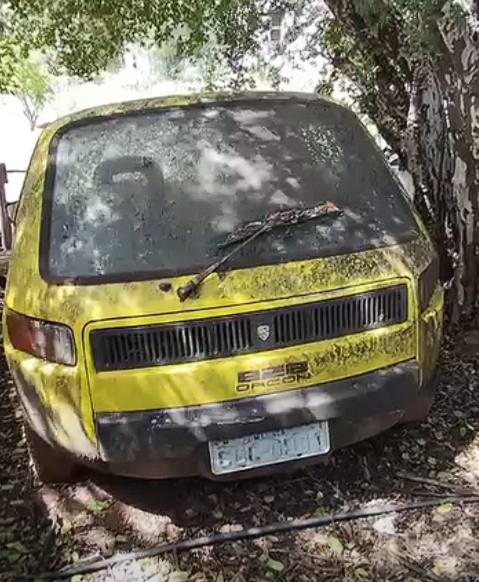
The yellow car that prompted this story wears an 828 DACON badge. Its compact shape belongs to a Brazilian experiment in making a desirable, comfortable city car. The badge and body support the model identification; the individual car's year and time in storage remain unverified.
A Brazilian urban-car idea
Small enough for the city. Desirable enough to own.
Dacon proprietor Paulo Goulart's project took shape around 1982, with Anísio Campos responsible for the design. Campos had worked across racing machines and road cars; the 828 applied that experience to a much smaller everyday brief. The ambition was comfort and character within a compact footprint.
Puma Classic records that early assembly began at Puma. The contemporary Quatro Rodas report describes two pre-series 828 S cars and a luxury specification. These early cars establish a development stage before the surviving production examples. The model's date is therefore not the build year of every 828.
Quatro Rodas — Anísio Campos profile and republished 2013 interview ↗Puma Classic — first assembly at Puma and the luxury urban-car brief ↗Quatro Rodas, January 1983, pp. 52–59 — original comparative road test, archived scans ↗Period specifications
Familiar components in a very short body.
Quatro Rodas's January 1983 test lists a 1,584 cc rear-mounted, air-cooled Volkswagen flat-four, a four-speed manual gearbox and rear-wheel drive. Its specification describes a fibreglass body, two doors, two seats, a 2.65-metre length and a 1.65-metre wheelbase.
The test gives 65 CV SAE for petrol and 68 CV SAE for ethanol. Its measured 0–100 km/h results were 20.52 and 16.31 seconds respectively. Those results belong to the two tested pre-series cars; later modifications, fuel specifications and surviving examples need their own evidence.
Quatro Rodas, January 1983, pp. 52–59 — original comparative road test, archived scans ↗Commercial history and visual influence
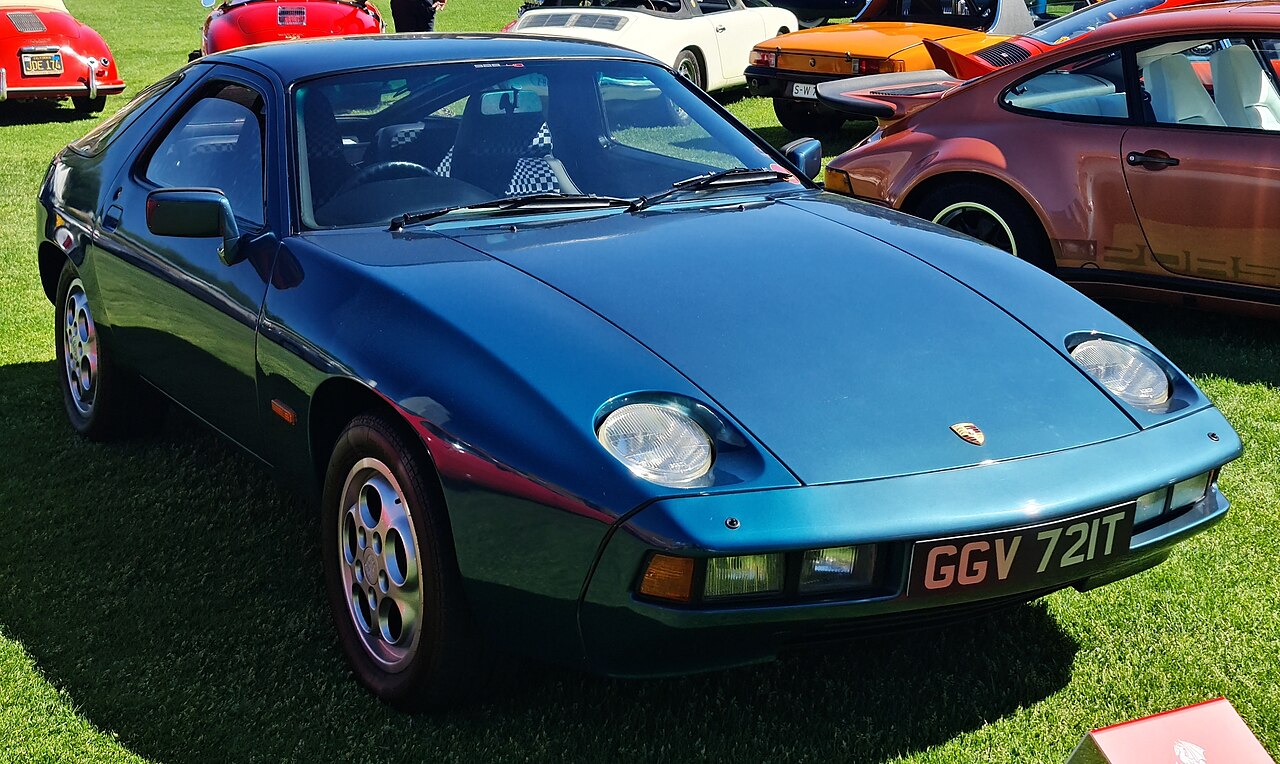
The 928 connection is visible at the rear.
Dacon had represented Porsche in Brazil. That commercial relationship helps explain the association, while the 828 remained a Dacon creation. Quatro Rodas's period styling assessment explicitly identifies the Porsche 928 as the inspiration, especially at the rear.
The mechanical basis was Volkswagen. A Porsche crest on a surviving car cannot establish a factory Porsche identity or its present engine specification. The 828 belongs to the history of independent design and the reach of Porsche's styling influence.
Goodwood, Gary Axon, 8 January 2019 — Dacon's Porsche connection and reported rarity ↗Quatro Rodas, January 1983, pp. 52–59 — original comparative road test, archived scans ↗Rarity and the limits of the record
A small series, with an unsettled final tally.
Goodwood reports 47 examples and sales continuing until July 1994. A separate Campos history gives 48 cars and an earlier production end in 1985. These accounts may reflect different definitions of completed cars, prototypes, production and later sales, but a factory register is needed to reconcile them.
The useful conclusion is its very small scale. We retain the commonly reported figure of 47 as an attributed estimate, rather than a verified total or a count of survivors. No reliable present-day survival census or current market valuation is established here.
Goodwood, Gary Axon, 8 January 2019 — Dacon's Porsche connection and reported rarity ↗Bandeira Quadriculada — Campos history, interview extracts and differing production account ↗A new programme in the 2000s
The idea returned as Obvio! 828/2.
Campos later revisited the compact-car idea through Obvio. ZAP's September 2005 filing identifies a running 828/2 prototype and a separate static 012 prototype, alongside an agreement for North American distribution.
The planned manufacturing and export volumes depended on approvals and deliveries. A contract or announcement does not show that those cars reached customers. The revival is a separate development programme: its proposed engines, electric variants and equipment must not be assigned to the original Dacon.
Bandeira Quadriculada — Campos history, interview extracts and differing production account ↗ZAP, Form 8-K, September 2005 — Obvio 828/2 prototype and conditional export plans ↗From urban proposal to design history
An original car entered the museum record.
The Museu da Casa Brasileira's 2016 report records an original 1982 Dacon 828 in its exhibition about Campos, which continued into 2017. The display placed the little car within a wider career in Brazilian automotive design.
Our contributor's yellow-car frames show a weathered survivor and the 828 DACON rear badge. They do not authenticate a chassis number, prove roadworthiness or establish the video's claim of 30 years in storage. The original 828, the later PAG cars and the Obvio revival remain distinct chapters.
Museu da Casa Brasileira — 2016 annual report, p. 62, original 828 exhibition ↗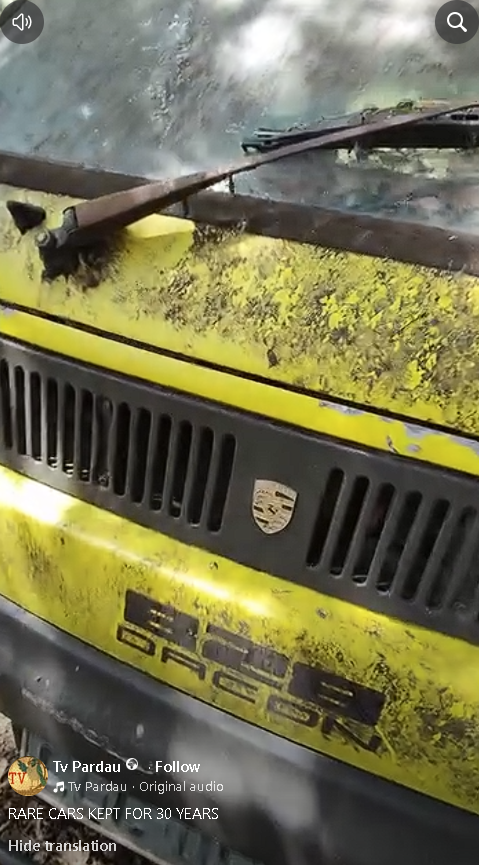
Sources reviewed 2026-11-17. This is a sourced model history rather than a chassis register. Dates, measured test results and reported production totals retain their specific context. Magazine scans are research references, not gallery photographs. The Porsche connection concerns Dacon's commercial history and the 928's styling influence.